From the floor of the unconscious, two people came walking side by side. The monk, in a red robe, smiled without a word. The player was happily tapping at something in his hands. They looked nothing alike, and yet, strangely, they seemed alike.
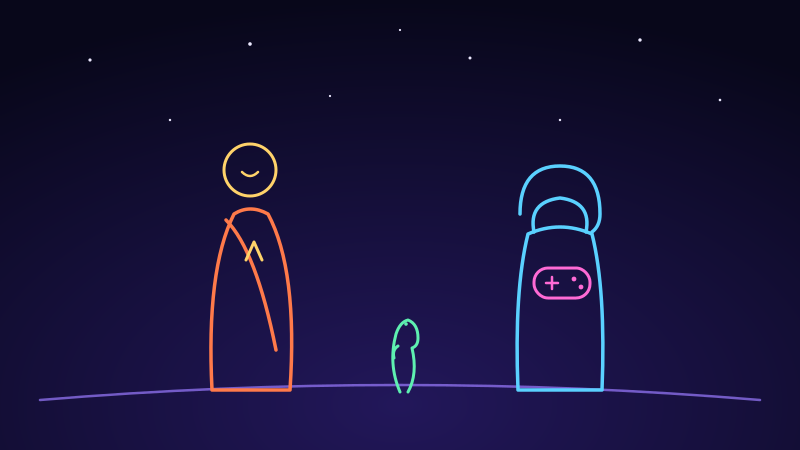
Back when I had lost everything, I studied those two faces for a long time. The Tibetan monks who smile calmly all day long. And a few people who seem to live life like a game.
The monk isn’t trying to score points. So he has nothing to lose. The player scores points, but knows it’s a game. So when he loses, he starts the next round. Neither lets the numbers set his mood.
Any two of us share 99.6% of our DNA.8 Vessels of almost the same shape. No one chose their own genes. So why do we fight each other? Who planted selfishness in us, so that we see each other as enemies? I looked for that answer for a long time. Each time, the meerkat asked. Any other explanation? Inside that 99.6% were the men at B’s dinners too. There, I couldn’t go on.
The answer I found then was this. What planted selfishness was the scoreboard. A board that rewards with numbers, a board that trains with fear. On that board we learned to see each other as rivals, as threats. The ones who made that board, and the ones pressing the buttons on it, were us in the end. So there is only one way to end the fight. Someone puts the scoreboard down first. This is about my own fight. It is not telling someone who was put in a chair by others to be the first to put it down.
AI that learns through reward and punishment, reinforcement learning, has a problem with rewards that come late. When the value of a button pressed now comes back much later, the brain gets confused about what it is being rewarded for and what it is being punished for.9 Maybe that late-arriving value is what people have long called karma.
The monk pointed to the meerkat. The observer’s seat, the spaceman’s eye. Looking from there, a line came to me.
Life is a game in which free will for a greater cause is rewarded, and free will for self-interest becomes karma.
Back then I read that rule as a bigger scoreboard. Karma as a punishment that arrives late.
The rule was asking me something. The wish to protect her, and the wish to find out the truth and win. The two lived in one body. The first was the greater cause; the second, self-interest. Telling them apart was the boss fight of this game, the battle with the strongest enemy, the one waiting at the end.
I took my finger off the button for winning. At least, I believed I did.
👽 Game rules unlocked